Showing posts with label Charleston. Show all posts

Wednesday, April 3, 2019

Spring Training 2019 - Day 59

We had another busy day planned for today.  The weather was much better with sunny skies and warmer temperatures, but still a little cool.

Our first stop was Patriots Point Naval and Maritime Museum.  It is located on the northern shore of Charleston Bay on the Cooper River and is home to the USS Yorktown (CV-10) a WW II era aircraft carrier, commissioned in 1943 and decommissioned in1975.  It is the second Yorktown carrier, the first being sunk in the Battle of Midway in 1942.

Patriots Point is also home to the WW II destroyer USS Laffey (DD-724), a famous ship that survived 22 Kamikaze attacks during the battle of Okinawa.  There is also a post WW-II diesel submarine, USS Clamagore (SS-343) berthed there.  In addition to the ships there is a Medal of Honor museum, an Apollo 8 Mission Exhibit, a Cold War Submarine Memorial, lots of historic aircraft and a unique Vietnam Experience exhibit, recreating highlights of the war in a living history format.


After touring the Yorktown and the Laffey we had lunch at the snack bar in the Yorktown and got ready for the next activity, a 15-minute boat trip and one hour tour of Ft. Sumter that departs from Patriots Point.

The trip out to the fort was pleasant.  It wasn't too windy and the water was almost calm.  Along the way we got to see lots of activity as the waterway is used by boats large and small.  There is also a very beautiful bridge across the Cooper River.

Ft. Sumter is now a National Monument administered by the National Park Service.  It is only accessible by ferry service by a park concessionaire. The trip to the fort takes about two hours, including travel time and is controlled by park service rangers, one trip at a time.

Ft. Sumter today looks very different than it did at the start of the Civil War.  It was continuously bombarded, first by the Confederates to start the war and later by Union Naval forces throughout the siege and blockade of Charleston Harbor until the war's end.  The fort was virtually destroyed, and after the war the Army attempted to put it back in shape. From 1876 to 1897 it was not garrisoned and served mainly as a lighthouse station.  The impending Spanish American War renewed activity there - deferred maintenance of the installation was addressed and new guns were installed.  During WW I the fort was garrisoned for the next 20 years.  The outmoded guns were removed during WW II and antiaircraft guns were installed late in 1945. The fort was then transferred from the War Department to the Park Service and designated a National Monument in 1948. It was a nice visit to a historic site and another old fort we have added to the list of ones we have visited. 

After we returned to Patriots Point we visited the Vietnam Experience exhibit.  It is like nothing we have ever seen before regarding Vietnam War History - a living history exhibit that attempts to create what it was like being there. 

You start in a Quonset hut containing displays and artifacts with a theater playing video clips of life and activity during that time  and reminiscences of veterans who were there.  You then go outside to exhibits, including a US Navy Advanced Tactical Support Base (Brown Water Navy), a US Marine Corps Artillery Firebase and the Battle of Khe Sahn during the Tet Offensive in 1968.  The exhibits are augmented by the sounds of gunfire, helicopter noise and other associated battle sounds including explosions.  There are also hoochs  with exhibits of a medical facility, living quarters and a mess hall.  There is also a gun/watch tower that sometimes guarded a compound in the field.

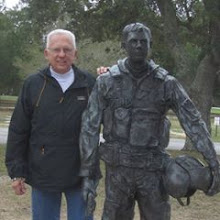
There were also Vietnam era helicopters and military equipment and weaponry on display throughout the grounds of the exhibit.  It was all pretty realistic as it could be, especially with the battle sounds.  I can see where the experience might be disturbing to some veterans who experienced Vietnam on the ground, bringing back unpleasant memories, but on the other hand, perhaps it might give children some idea of what their parents and grand parents went through back then.


We then drove back to the RV park after another long but enjoyable day.  We leave for Columbia, SC, the state capital, tomorrow, finally turning west on our journey home.


Tuesday, April 2, 2019

Spring Training 2019 - Day 58

It rained hard last night into this morning so we waited a bit before heading into downtown Charleston to see the sights.

Our plan was to start at the Charleston City Market, a historic market place started in 1807.  It is a bit "touristy" today but they sell a lot of local arts and crafts items and art works.  The highlight items are the sweetgrass baskets made by the descendants and members of the historic Gullah black community.  

The Gullah are descendants of slaves from west Africa who were brought to America, starting in the late 16th Century.  They worked on rice plantations in what is now called the "low country", stretching along coastal areas and sea islands from Jacksonville, Florida to Cape Hatteras, North Carolina.  As Charleston was the primary location for the importation of slaves, it now has the largest concentration of Gullah peoples but their cultural heritage is present all along the Georgia and South Carolina coastal regions.

The slaves imported to work on the rice plantations in America had a long history of rice cultivation in the areas of west Africa where they came from - many were skilled in growing rice and were highly valued workers.  Due to the relative isolation of the rice plantations along the low country coastal region, the slaves had little contact with others outside of their plantations.  Over time, they developed a sort of Creole pidgin English that has been passed on and is still spoken today.  Likewise, much of their culture brought from African has been retained and passed along to the next generations.  Even during and after the Civil War as the slaves were freed, outside influences did not greatly impact their culture.  Despite being some of the first slaves freed and even fighting for the Union as all-black regiments, they remained a distinct ethnic culture that still exists today.

The sweetgrass baskets they still make  have become prized collectibles and are very popular with tourists  and collectors alike.   The baskets are made from bulrush and palm and are coiled in decorative and attractive designs.  All are handmade and are not only decorative but functional, reflecting their evolution from agricultural implements to beautiful household items.  So we bought one to add to Judy's basket collection.  Here is a picture of a typical basket (not ours but similar):


After walking around and having lunch at a biscuit place in the market, we travelled up the street a bit to the city visitors center.  It is an impressive facility, housed in a historic railroad yard barn and very busy.  There is a lot of tourism going on here and they are well equipped to handle it all. 

The visitor center is also a transportation hub where group tour buses and vans load and unload and city buses transport people around town on free on-and-off shuttles.  

Next , we took a guided tour in a van around to all the major highlights in the historical district and along the waterfront.  The tour took about two hours and afterward we visited a nearby historic plantation house.

The house was built by descendants of French Huguenots who came to America in 1695. Joseph Manigault built the house in 1803 - it is an excellent example of Federal style architecture.  The family had acquired great wealth first as merchants and later as rice planters during the 18th Century, owning 4 plantations and over 250 slaves.

They lost it all after the Civil War and the house has had a checkered history since then, even serving as a billet for GIs during WW II.  The Charleston Museum acquired the building in 1933 and after WW II began an extensive renovation. In 1973 it was designated a National Historic Landmark for its exceptional architecture.

After the tour we had a "Tequila and Tacos" early dinner at a nearby restaurant then headed back to the RV park, about 14 miles away.  It was a long but very enjoyable day.

We were impressed with Charleston. They have done an exceptional job with historical preservation and the downtown historic district is very attractive.  There is a lot of history here and plenty of interesting things to do and see.


We are going out to Ft. Sumter tomorrow and also visit several historic naval ships, including the aircraft carrier Yorktown at Patriots Point.